See all MOPAR parts See all Chevy/GM parts See all Ford parts
See all pistons See all rods See all trannys
click to send us an e-mail !
Website Sections:
CE Home Page
Site Index
Aluminum Motor Plates
Automatic Transmissions, parts, accy.
Balancers, Harmonic Dampers
Bearings
Connecting Rods
Crankshafts
Custom Pistons
Dampers, Harmonic Balancers
Deep Transmission Pans
Double Roller Timing Chain Sets
Engine Rebuild Kits Overhaul Kits
Flexplate Shields
Flywheels Flexplates
Gift Certificates
Mid Plates Steel & Aluminum
Motor Plates
Oil Pumps
Pistons
Piston Rings
Rocker Arms
Rotating Assembly
Shields, Trans and Flywheel
Stall Converters
Stroker Kits
Timing Chain Sets
Torque Converters
Transmissions
Transmission Brakes Tranz Brake
Transmission Pans
Transmission Overhaul Rebuild Kits
Transmission Shields
Ultra Bell Bellhousing
Ultra Case Powerglide Trans Case
Valves Intake & Exhaust
Valve Bodies Manual Shift
© Campbell Enterprises

Manley Tech Report "A Primer On Camshafts"

Getting the best possible performance out of your vehicle, be it a street car, restored muscle car, street rod, hot rod, all out race car, boat or pulling truck, requires the proper combination of parts. The better your understanding of the inner workings of your engine, the better will be your ability to build an engine which will provide strong torque and horsepower and live in the demanding environment which it operates in.

How to build high horsepower engines is an often asked question. We will try to help you be able to build a better engine by providing a series of tech articles that will help you better understand the inner workings of your internal combustion engine. The more you understand about building or rebuilding a stock, high performance or racing engine, the better prepared you will be to make the best purchasing decisions when buying parts for your project. The following article gives excellent information on how a camshaft operates and how it affects the performance of an internal combustion engine. This article is reprinted with permission from Manley Performance Products, Inc. We here at Campbell Enterprises thank Manley for allowing us to share this valuable information with our customers.

A PRIMER ON CAMSHAFTS
by Henry D. Manley III

The camshaft has been called the heart of the internal combustion engine, and there is a great deal of truth in this statement. The camshaft controls the valve train making possible the entire four cycle event. In stock American passenger car engines the camshaft is designed to deliver smooth quiet idling and good low speed performance. To achieve these ends as much as one fifth of the potential horsepower is sacrificed for two basic reasons. First, the valves are not moved off their seats radically, and second, the valves are not left open for long durations. Of course, there is some overlapping of the valves, and this is not particularly condusive to good performance, but at high engine speeds this overlap actually becomes beneficial as will be shown later.

A racing camshaft basically opens the valves higher and leaves them open longer than a stock camshaft. However, the exact profile of the cam, that is, how the cam actually accomplishes this event, is of primary importance. The ideal situation would have the intake valve snap open instantly at approximate top dead center ( TDC ) and remain open until 40° degrees after top dead center ( ATDC ). Unfortunately, such instantaneous action would pound the valve train to pieces and prove completely impractical. Therefore, even racing camshafts are a compromise between stock cams which activate the valve train only mildly and some yet-to-be invented instant valve opener.

Racing camshafts are designed to open the valves sooner and leave them open longer than stock cams, as well as lift the valves higher. The exact number of degrees that the intake valve opens ( BTDC ) and closes ( ABDC ), and the exhaust valve opens ( BBDC ) and closes ( ATDC ), depends of course on the grind. Each shaft is ground for a primary purpose, as explained later, but regardless of the grind there is more overlapping of the valves than with a stock cam. This overlap is inevitable because of the increased duration, but at high engine speeds some benefit is derived from the overlap as there is a mild supercharging effect of the exhaust gases which tends to suck in additional fuel and air. The basic reason for overlap can best be explained by an examination of the four cycle event.

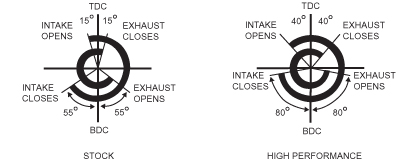
The intake valve starts to open before the piston reaches TDC on the exhaust stroke of the previous cycle. In this way the valve will be fully open by the time the piston moves over TDC and down on the intake stroke. The incoming charge of fuel and air builds up a form of kinetic energy which causes the mixture to continue flowing into the cylinder after the piston has reached BDC and starts up on the compression stroke. The intake valve finally closes at some point 60° degrees or more ABDC so that there is no throttling effect on the incoming fuel which would cause a limitation on the engine's top speed performance. When the piston is at TDC on the power stroke both valves are closed to seal off the combustion chamber for the explosion of the fuel mixture. As the piston travels down on the power stroke the exhaust valve begins to open 60° degrees or more BBDC. A slight loss of power results from this early opening of the exhaust valve, but the overall effect is positive because the exhaust gases begin to escape the combustion chamber under their own power thus avoiding a throttling effect on the piston as it moves up on the exhaust stroke. The exhaust valve remains open after the piston has reached TDC because the kinetic energy built up by the escaping gases actually causes the gases to continue to flow even when the piston has started down on the intake stroke. The piston's transition at TDC from exhaust stroke to intake stroke is precisely the area where overlap occurs. As illustrated by this review of the four cycle event, the exhaust valve is open ATDC to allow more complete scavenging of the chamber, while the intake valve opens BTDC to facilitate the flow of the incoming charge. The actual amount of overlap can be quite large, especially in camshafts designed for top end performance. As previously explained, this large overlap will effect low speed performance to such an extent that the car may even run slower at low r.p.m.'s with the racing cam than it did with the stock cam. For this reason great care should be exercised when deciding which cam should be used in an engine.


The illustration above shows the difference between the 4 cycle event with a stock camshaft and a high performance camshaft.

Return to Other Website Sections:

Car Talk Section Campbell Enterprises Site Index Campbell Enterprises Home